

It was a dreary afternoon in the fall of 1985 when I first met Mabel Claire. The weather matched my mood. I had returned to Buffalo in the late Spring. Within a few weeks I had taken a job I had come to hate, and truly f**cked up the relationship that led to my leaving Ohio. Part of my solace came from delving deeper into the world of cooking.
The place was The Haunted Bookshop, around the corner on Elmwood (The Intersection Coffee Shop is there now). I had passed it on my way to the Towne for a 4 am breakfast, but on this day I was strolling by during business hours. I went in, and came out with, among other volumes, two new additions to my nascent cookbook collection. One of them was the J. N. Adam cookbook by Mabel Claire1. The other was Craig Claiborne’s A Feast Made for Laughter—that will get a post of its own. I had no idea who, or what J. N. Adam was, but the name “Adam” meant Department Store in Buffalo as “Sibley” did in Rochester—so I suspected a connection.
I was right.
James Noble Adam founded the department store in 1881 until it closed in 1960. Adam’s brother Robert Borthwick Adam had earlier been a founder of the more famous Adam, Meldrum & Anderson department store. AM&A’s was still around when I purchased the book, operating its Downtown location in the building that was formerly J. N. Adam2.
I had my first cookbook of local provenience, written especially for a once well-known local business. Or so I thought.
A few years later I was visiting friends in Pennsylvania, and being nosy I was looking at their cookbook collection. I found the Gimbels Cookbook—by Mabel Claire. Except for the name of the department store it was identical to my Adam cookbook.3
 So, who was Mabel Claire? How could someone whose cookbooks seem ubiquitous in the 1930s be so lost from history?
Remember, in 1988 the Internet was in its infancy. AOL and dial-up access were still a few years in the future. Research of this sort was conducted at the main library using the Reader’s Guide to Periodical Literature—thumbing through volumes of old magazines, or scanning page after page of microfiche. Probably sounds quaint now.
Things have changed. Search engines and resources such as the Food Timeline make research much easier, and my cooking resource library has grown substantially. Here’s what I found.
Mabel Claire, the pen name of Mabel (Mrs. Jack) Bechdolt, was an American writer of cookbooks and domestic guides active in the 1920s and early 1930s. Born in Aberdeen, Washington, as Mabel Glasier—the daughter of a school superintendent—she trained as a sculptor at the Art Students’ League in New York and worked as both an artist and small-scale manufacturer.
Despite the wide circulation of her work, relatively little biographical detail—and no widely recognized photograph of her or her work— has surfaced.
Her interest in efficiency grew out of balancing artistic work, business, and household responsibilities, leading her to develop the time-saving methods that became the basis of her cookbooks. Published by Greenberg, her books were widely distributed under department store imprints, often with identical text appearing under different names4.
Her husband, Jack Bechdolt, was a writer of works including The Torch, a post-apocalyptic dystopian tale that, while dated and at times jarringly misogynistic, is still an interesting read.
She died in July 1933 at the age of 435.
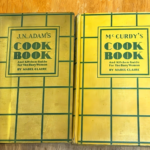 So far I have managed to identify sixteen different department store versions, which doesn’t count volumes that Mabel published under her own name. No, I haven’t collected them all, just the Adam for Buffalo, of course, and the McCurdy’s for my hometown of Rochester6.
Mabel Claire was, in her own way, ahead of her time—not because she pushed back against domestic life, but because she redesigned how it worked.
Drawing on her experience as an artist, business owner, and housewife, she treated cooking like a problem of timing and workflow. Her books feel less like recipe collections and more like systems: menus matched with shopping lists, meals broken into timed steps, instructions that read almost like schedules.
Without modern appliances, she leaned hard on what she did have—meat grinders, make-ahead prep, and smart sequencing—to turn long tasks into short ones. In an era when domestic labor was often tied to ideas of virtue, she approached it as something to organize and streamline.
But she never sacrificed pleasure in the process; she cared about color, form, and presentation just as much as efficiency. The result isn’t a rejection of the kitchen—it’s a rethinking of it.
That also impacts the efficacy of this as a cookbook. You don’t reach anything like a standard recipe section until page 262—almost two-thirds of the way through the book. The rest is organized by menus. That makes the text clunky, but the index is pretty good.
As a practical cookbook, there were better choices even in its own time.
To test the reliability of the recipes I selected one, mostly at random, and gave it a try. Here are the results of my Tamale Pie experiment.
Oh, one last thing. In my mind she will always look like this:

Notes
1 The other was Craig Claiborne’s A Feast Made for Laughter. That will get a post of its own. ↩
2 A trip to AM&A’s on Main Street was once an event, when downtown hummed with activity and shoppers had their pick of dozens of retail outlets. It was founded in 1867 by Robert Adam and remained a Main Street stalwart and in his family as Adam, Meldrum and Anderson for more than 125 years. Even today, a mention of the store to a Western New Yorker of a certain age will evoke memories of holiday shopping trips and pausing to look at the Christmas displays in the windows. And now↩
3 Stepping into the long-vacant AM&A’s department store building downtown is like stepping into the past. But anyone who remembers what the flagship department store was like would be shocked to see how it’s crumbled in the nearly three decades it has been empty. . . Water pours from a newly broken roof drain pipe on the ground level, above the sunken landing, collecting in a pool next to patches of slippery ice on the floor. It’s utter darkness − damp and cold − as we climb the rusting steps of the back staircase to the main first floor with flashlights in hand, while dodging debris. There’s no heat in the building, though there is temporary electricity as needed. David Robinson News Business Reporter. 2026. “Sam Savarino on State of the AM&A’s Building.” https://tinyurl.com/2c4d2vlw ↩
4 In fact, it was late January, 1988 – the weekend I turned 30. I found out a surprise party was being planned and skipped town to visit me SiL’s family… ↩
5 New York Times, July 29, 1933 obituary of Mrs. Jack Bechdolt. ↩
6 I only wish it were Sibley’s—that’s where my parents met. ↩