

Now that Passover has ended, permit me to remark upon something that I have observed over recent years: Prepared horseradish does not keep its flavor as well today as it has in the past.
Horseradish and mustard are pretty much the only piquant condiments in the Ashkenazi Jewish pantry. Of course, horseradish and mustard are pretty much the only condiments throughout Northern and Eastern Europe. This is, of course, a broad over-generalization, but it’s pretty much my Blog. It is also pretty much true. (Also, a local company has pretty much created the perfect marriage between the two).
Mustard’s place in Jewish cuisine is well established. A thick stack of still warm, hand-carved, corned beef piled between fresh seeded rye screams for a dab of true deli mustardi.
Horseradish occupies another space in our lives. There is an old Yiddish proverb: To a worm in horseradish, the whole world is horseradish.
To heck with the worm, to an Ashkenazi Jew during Passover horseradish is everything. Horseradish is the maror on the seder plate. Horseradish is combined with charosetii to make the Hillel sandwichiii. Horseradish makes the Gefilte Fish better – though many would say it simply makes it edible. That’s a debate for another post.
Thank you, horseradish, for being neither a radish nor a horse. What you are is a liar food. –Jimmy Fallon
But why horseradish? מָרוֹר (maror) simply me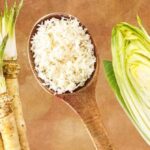 ans “bitter”. In Exodus 12:8 the word used is the plural מְרֹרִים (marorim) the literal translation of which is: bitter things. Between the 3rd century BCE and the 1st century CE it seems to have settled as meaning bitter greens or herbsiv. The Midrash and Talmud leave us with a list and descriptions of what greens/herbs are acceptable for the seder. You are welcome to follow me down this rabbit hole.
“The key to the accompaniment to the paschal offering is in its name—it must have a bitter flavor. The text’s usage of the plural form marorim reflects that more than one item is acceptable for the commandment and that the term does not simply refer to a single plant called maror”v .
Horseradish is not on the list. “Horseradish was unknown in Israel in Talmudic times and was not among the five vegetables cited by the Talmud as acceptable for maror” and the first approval of its use at seder is in the 14th century CEvi.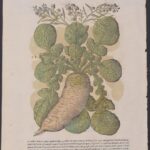
A native of Eastern Europe and Western Asia, it is neither an herb nor a leafy green vegetable. A member of the mustard family, it is known for its pungency not its bitterness. The heat of horseradish stems from the same oil – allyl isothiocyanate – as mustard, true radish, and wasabi. At least as far back as 1st century CE Greece, it was known for its medicinal properties:
The wild radish (which the Romans call armoracia) has leaves similar to that which is sown, or rather more similar to those of lampsana. The root is slender, soft, and somewhat sharp; both the leaves and root are boiled instead of vegetables. It is warming, diuretic and burning.vii
It is the grated root of the plant that is used for Passover, and not the edible leaves. The flavor of the leaves has been described as “sharp, bitter, and peppery with a taste similar to kale and arugula”viii. They would seem more appropriate as maror. I think the answer is botanical. The plants approved by the Rabbinic authorities don’t grow as well in Northern climes. If they do grow, their season is later than April 24th, the last day Passover can occur. Even horseradish may not sprout sufficient foliage that early, as was demonstrated by parsley crop this Spring. Plating tongs were needed.
Yet the answer may be more prosaic. It was a popular condiment in the Middle Ages in those countries where Ashkenazi Jews settled as they migrated eastward following the Crusades. It went with Passover foods. Hence the Yiddish proverb: Gefilte fish without chrain (horseradish) is punishment enough.
In the Haggadah it states: This bitter herb which we eat—what is its meaning? It is eaten because the Egyptians embittered the lives of our ancestors in Egypt, as it is said: ‘And they embittered their lives with hard labor, with mortar and with bricks, and with all manner of labor in the field; all the labor which they made them perform was with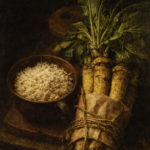 rigorix.’ Horseradish can induce tears – as appropriate a reminder as any bitter leaf.
But what if it didn’t produce tears? What if what is in that jar has all the appeal of vinegar-pickled pencil shavings? If it doesn’t bite… is it worth eating?
I am well aware that what we perceive as pungency, or spiciness, is usually the result of volatile compounds contained in the seasoning. In this case the allyl isothiocyanate mentioned above. The moment the cells are crushed enzymatic action commences. This is the moment of peak piquancy. Exposure to air allows those compounds to dissipate, reducing the intensity of the flavor. Storing an open bottle of horseradish in the refrigerator will slow, but not stop, that diminution. While we are used to the flavor of vinegar in horseradish, its addition is not for taste. It is to slow the degradation of the evaporable substances.
Wegmans and Broadway Market are simply horseradish and vinegar. Gold’s, Ba-Tampte and Boar’s Head add salt to the mix. Kelchner’s is horseradish, distilled vinegar, water, salt, natural flavoring; Bubbies grated horseradish roots, water, distilled vinegar, salt, sugar, and natural mustard oil. The local Miller’s brand counters the degradation with: horseradish, distilled vinegar, water, soybean oil, salt, artificial flavoring, sodium bisulfite (to protect color and flavor) (Emphasis added.) It keeps its “flavor” longest of the refrigerated brands.
Bookbinders, a shelf-stable brand is: horseradish, distilled vinegar, water, corn starch, soybean oil, salt, artificial flavor, sodium benzoate and potassium sorbate (used as preservatives), calcium disodium-edta & sodium bisulfite (to protect color and flavor). Yum.
The formulae are not new, it just seems that over the past decade or so that reduction in strength happens faster. Leaving only bitter dregsx. Of course that leads the curious me to wonder why? The likely answer is, as it always seems to be these days, cost cutting. Mass industrial production always favors consistency and shelf-life. Have they reduced the volume of product, while keeping the bottle the same, increasing the amount of oxygen in the jar? Are they adding the acid earlier to speed up production? Is it hanging around too long?
Maybe it is the roots themselves – mishandled or old. God forbid, are they breeding milder roots, the way the food industry has ruined Jalapeños?
The answer may be to grate your own. The roots I find here are usually huge, but it freezes pretty well. I am also informed that if you take a chunk and pot it, you end up with you own supply (and a house plant). Here are a couple of recipes.
In the immortal words of Tevye the Dairyman: Horseradish that does not bring a pious tear to the eye is not God’s horseradish. Who wants to argue with Tevye?
Amen.
____________________________________
i My choice is Ba-Tempte, but Jews love to argue – so have at it.
ii Charoset is a sweet, dark-colored mixture of finely chopped fruits and nuts eaten at the Passover Seder.“Charoset.” Wikipedia.
iii “What We Can Learn from the ‘Hillel Sandwich’ | Reform Judaism.” March 26, 2026. Reform Judaism
iv The time period between the Septuagint and Josephus.
v Marks, Gil. Encyclopedia of Jewish Food. John Wiley & Sons, 2010, p. 389.
vi Id. at 265
vii Dioscorides Pedanius, Of Anazarbos, et al. Dioscorides de Materia Medica : Being an Herbal with Many Other Medicinal Materials. Johannesburg, Ibidis, 2000, P. 260
viii “Horseradish Leaves.” Specialtyproduce.com, 2020, Specialty Produce
ix The Maxwell House edition, of course.