

I have always loved a good sandwich. In many ways it is a perfect food stuff,  chameleonlike in its nature and build. “Age cannot wither her, nor custom stale Her infinite variety…The appetites they feed, but she makes hungry Where most she satisfies.[1]“
The debate as to what does or does not qualify as a sandwich (taco, hot dog, etc.) is mere pedantry. The quest to determine the  “inventor” of the sandwich is an exercise in futility. The directive of Rabbi Hillel was not an origin, nor was the naming of such a construction after the noble gambler John Montagu an “invention.”[2]
Bread, in its most basic form, consists of flour—any flour—and water, the resulting paste exposed to heat. Most likely, the sandwich originated in utility. The hand is a lovely implement for dining, but is not designed for grasping hot food, to say nothing of sanitary concerns. To my mind, the sandwich was born as a utensil, descended from the sop or the scoop—or both.
For the scoop, consider a round of injera bearing a ladle of doro wat and other stews; or pita with baba ghanoush; or chapati, blini, even a plate of tortilla chips slathered in “cheese” sauce. The bread is the implement used to carry food, and the implement is then consumed.
For the sop—or, more properly, the trencher—the bread serves as plate or bowl. When the course is finished, the vessel may itself be eaten, or given away as a literal sop to the masses.
My conclusion: if bread is used to convey food to the mouth, or to support it as a vessel, it is a sandwich—at least until someone offers a better name. Selah.
“Sandwiches are wonderful. You don’t need a spoon or a plate!” — Paul Lynde
My own perception of the sandwich coalesced, in part, around Laurence Sanders character of Chief Edward X. “Iron Balls” Delaney (ret.). Delaney has been well-noted as a connoisseur of the Art of Sandwich making. His Credo was set forth in The Third Deadly Sin (which, oddly, is his fourth appearance in print):
FORMER CHIEF OF DETECTIVES Edward X. Delaney had two methods of eating sandwiches.
Those he categorized as “dry” sandwiches—such as roast beef on white or what he termed an interracial sandwich, ham on bagel—were eaten while seated at the kitchen table. The top was spread with the financial section of the previous day’s New York Times.
The meal finished, crumbs and newspaper were crumpled up and dumped into the step-on garbage can under the sink.
“Wet” sandwiches—such as potato salad and pastrami on rye, with hot English mustard, or brisling sardines with tomato and onion slices slathered with mayonnaise—were eaten while standing bent over the sink. Finished, Delaney ran the hot water and flushed the drippings away.
Both methods of dining were anathema to the Chief’s wife, Monica. She never ceased in her efforts to persuade him to adopt more civilized eating habits, even if it was only a midday snack[3].
Ah, how those words clung to me like mustard on fresh rye.
As much as I revel in the choices that abound, I do, in fact, have a list of five favorites. At the top of that list is: The Reuben.
Two slices of good Rye Bread, Swiss Cheese, Sauerkraut, Russian Dressing, and good Corned Beef. A healthy amount please. Allen Sherman’s words, “Do not make a stingy sandwich; pile the cold cuts high! Customers should see salami coming through the rye.” applies to corned beef as well. With a wedge of half-sour pickle on the side and washed down with a Dr. Brown’s®.
My deli experience began with Fox’s at Twelve Corners in Brighton, NY. Let me tell you, Fox’s made the best Reu—. But of course, they didn’t. Fox’s was then a Kosher deli. This is the Reuben paradox – how a sandwich that has all the hallmarks of the Jewish Deli, could not be made in a true Jewish Deli[4].
The origins of the Reuben have been disputed, with the dueling claims of Arnold Reuben’s Delicatessen in NYC origin versus a poker game in Omaha for a poker player named Reuben Kulakofsky (then again, it might have been 35 miles away in Lincoln, NE). I find it of some note that the evidence for the former is anecdotal, and the Nebraska claim has been oft mentioned but never shown. Not even a picture of someone holding it.[5]
Consider this origin story:
Another, less frequently cited origin places the sandwich somewhat earlier, and somewhat farther east—among Alsatian immigrants to Quebec, for whom the combination of rye bread, preserved cabbage, and beef would have required no explanation. The cheese was the native Muenster, and it was dressed with a spread of Moutarde de Alélor.
Once in North America— Montreal is usually suggested, though without  firm evidence—the sandwich encountered smoked meat, at which point it achieved a kind of perfection. Ranch Dressing replaced the mustard. Pressed under a hot curling stone, the resulting sandwich, structurally complete if not yet canonical, appears to have circulated quietly around Quebec and the Maritime Provinces.
The version known today emerges only after the sandwich migrated to Toronto, where the smoked meat was replaced with corned beef and the cheese with the less fragrant Swiss. For reasons that remain unclear to some – yet obvious to the keen observer – the Ranch was replaced by Russian dressing. Toronto is close enough to Buffalo to know that it is Never Ranch.
This last explanation is, of course, the product of my own absurd imagination. However, it bears as much importance to one’s the enjoyment of the sandwich as the other three origin stories – which is to say none.
More likely, the sandwich is the result of the natural evolution of this foodstuff from the utilitarian to the luxurious. A natural progression from a method of grasping, and conveying a foodstuff to a delectable bite.
One of the first recorded recipes for a sandwich appeared in 1773, during the lifetime of the famous sandwich Earl:
Sandwichs.
PUT ſome very thin ſlices of beef between thin ſlices of bread and butter; cut the ends off neatly, lay them in a diſh. Veal and ham cut thin may be ſerved in the ſame manner[6].
Prior to the mid to late 19th Century cookbooks, other than the occasional mention of a pasty[7], you can barely find crust or crumb of a sandwich recipe. This, from 1832 is an example:
SANDWICHES, (2) Properly prepared, are an elegant and convenient luncheon or supper, but have got out of fashion, from the bad manner in which they are common- I made: to cut the bread neatly with a knife seems to be considered the only essential, and the lining is composed of any offal odds and ends, that cannot be sent to table in any other form. Whatever is used must be carefully trimmed from every bit of skin, gristle, &c. and nothing introduced but what you are absolutely certain will be acceptable to the mouth[8].
By the time of the fin de siècle food economists, sandwiches had morphed from a portable food to a Victorian Tea Sandwich. To wit Sarah Tyson Rorer’s 1895 Sandwiches:
Corned Beef Sandwiches
Chop sufficient cold cooked corned beef to make a pint. Add to it a teaspoonful of horseradish, four tablespoonfuls of melted butter or olive oil and four or five tablespoonfuls of finely-shredded water cress. Put this between slices of buttered whole wheat or brown bread; trim the crusts and cut into triangles[9].
Makes me want to type with my pinkies out.
The same period saw the rise of a different approach to food – the world of the short order cook. Diners, Lunch Counters, and even bars catering to the urban worker. Trimmed crusts and finely chopped meats were out. All of the ingredients were part of the sandwich makers art. Somebody put them all together and made something sublime. I neither know nor care whom.
As far as I can determine, the first cookbook reference to a Reuben, as such, is 1939[10].
RUBEN (sic) JUNIOR-Rye Bread, Switzerland Cheese, Sliced Corned Beef, Sauerkraut, Dressing.
While it doesn’t mention griddling, and it doesn’t specify “Russian” dressing, all the ingredients are there. By World War II, this sandwich had made its way into Professional foodservice guides.
At a restaurant, it is a testament to quality. Like a good burger it isn’t difficult, but done properly it ensures a return visit. A bad one lingers like an unexpected fart.
At home, with a few caveats, it’s relatively easy to create a great one. First and foremost, the bread. Bad rye will rend your soul. Unfortunately, it is harder to find than ever. I make a tasty rye bread, but I have never been able to find that right balance and texture for a Reuben. Same with the wonderful “artisanal” bakeries we have been blessed with of late.
So, I go with store bought. Al Cohen’s, a local choice is quite good. Wegmans is my go-to. It comes closest to the rye bread of Fox’s of my memories. Find one that works for you.
The meat is also often an issue. A quality deli is a dying breed, and if you are lucky to have one it is usually about $5.00 more per pound than a supermarket. You can cook your own (I corn my own Brisket most of the time – because I can), but that requires planning. Except for March 17th. So supermarket it is. Ask for samples and find one you like. This is one of those cases where cost ≠ quality.
The sauerkraut – again I make my own. If that isn’t in your milieu go for store bought. But, skip the aisles and go to the refrigerator case (with the good pickles). Your tummy will be happy. Standard Swiss cheese is rather tasteless, and true Emmental is pricy. I go with Jarlsberg (same for Onion Soup).
Finally, the dressing. The classic is Russian, though in the US it often swapped for the similar 1000 Island. Like cocktail sauce it is better (and cheaper) to make your own. You may have all the ingredients in your fridge or pantry, and you can experiment with flavors.
I like some heat in mine.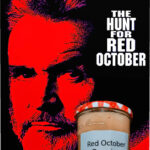
I dubbed my result Red October Dressing (best spoken with a pronounced Scottishaccent) The recipe is appended. In the words of James Beard: Too few people understand a really good sandwich. I hope to convert them – one slice at a time.
Because life’s to short to eat bad food.
[1] Antony and Cleopatra (Act II, Scene II)
[2] As an aside. a friend with a London Police Box that it was, in fact, created in a settlement south of the Taurus Mountains, near the banks of the Euphrates River. The inventor was a Neolithic hominid named Ghnash, from whom we derive the Yiddish nashn, and thence our modern “nosh.”
[3] Sanders, Lawrence. The Third Deadly Sin. Open Road Media, 12 Feb. 2013.
[4] It is just a personal hunch that many Kosher Delis that become Kosher Style Delis do so because the Reuben is a best-seller. At right is the offering at the present day incarnation at Fox’s.
[5] It is presented as fact in the volume Joslyn presents Bernard Schimmel’s Masterpieces,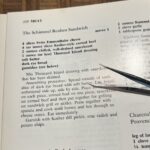 Joslin Art Museum, 1976.
[6] Mason, Charlotte. The Lady’s Assistant, for Regulating and Supplying Her Table. 1773.
[7] Yes, a Pasty is a sandwich. My Blog, my rules.
[8] Lee, N. K. M. The Cook’s Own Book: Being a Complete Culinary Encyclopedia. Reprint edition. Edited by Louis Szathmáry. Arno Press, 1972 at 182.
[9] Rorer, S T. Sandwiches. Arnold and Company, 1895, 1912 at 53.
[10] Dahl, J. O. 1893-1942. Menu Making for Professionals In Quantity Cookery: a Reference Book for Food Executives In: Hotels, Restaurants, Clubs, Schools, Fountains, Tearooms, Resorts, Camps, Cafeterias, Hospitals And Institutions. Stamford, Conn.: J. O. Dahl, 1945.