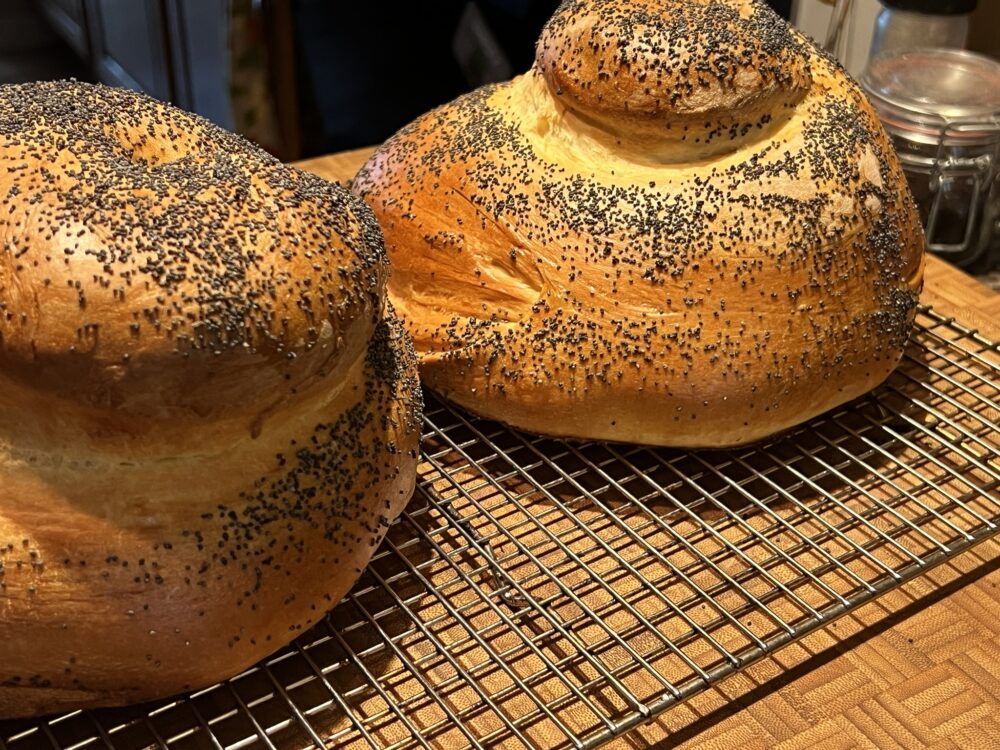
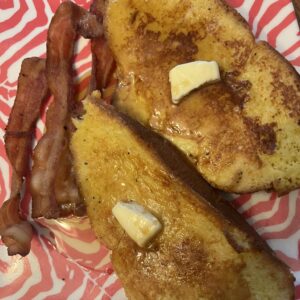
One of the things I enjoy most about celebrating Rosh Hashanah is making the traditional holiday Challah. It not only makes a great French Toast, but it is formed into a turban shape rather than being braided. I hate braiding – because I really suck at it. I’m a boy with curly hair. What do I know of braiding? Yeah, I sucked at Boondoggle too.
 New Year’s is not the only time I make Challah of course. Sometimes you just make it for the hell of it. See, French Toast, above. But it’s almost a necessity to have it when celebrating a Jewish holiday. A holiday without Challah would be like French toast without good dark maple syrup.
Except, of course, for Passover.
Which brings us to Paul Hollywood. The celebrity baker, cooking instructor and host of the popular Great British Bake-Off produced a cookbook called How to Bake in 2012. Contained therein is a recipe for “Cholla Bread ” [sic]. At first, it’s the name that catches the attention. It’s awkward but not a misspelling. I’ll get to that later.
No, the initial problem is contained in the introductory paragraph:
The recipe for this classic Jewish loaf was given to me by an old family friend, Sylvia Woolf. Despite the richness of the dough, the bread is very light, with a delicate sweetness from the sugar and milk. Traditionally served at Passover, it is good at any time of the year for breakfast or tea, just sliced and buttered1.
Of course, an enriched bread as a delightful treat for Passover, which, as most people know, is a Jewish holiday where bread is not consumed in any form. (irony added) I admit, that this is not to the level of cultural illiteracy one would have in say “celebrate Eid al-Fitr with this luscious Ham Tajine”, or “It wouldn’t be Diwali without a spicy Tandoori Beef.” But it rises, at least, to the level of “Liven up your Lenten Days of Abstinence with these lovely Braised Short Ribs”.
It may be naïve to expect that most people have a basic familiarity with the nature of a Jewish holiday. That being said, you don’t have to be a Talmudic Scholar to do Due Diligence. Use a search engine or read a book. Ask someone – people tend to enjoy talking about their heritage. Do some research. Would you publish “Celebrate Tết with this traditional Pollo a la Brasa” without taking five minutes to find out whether Pollo a la Brasa is actually a Vietnamese dish? Would you put your name on an article describing the Patate e Pomodori al Forno2, served at the Triumph of Germanicus in 17 CE3?
This isn’t just about Mr. Hollywood. This book presumably passed through editors and proofreaders. Advance Reader Copies? Somebody should have caught the error before it went to press. I guess nobody did – until sometime, apparently during the first printing, it was finally discovered and addressed.
They changed one word –
The recipe for this classic Jewish loaf was given to me by an old family friend, Sylvia Woolf. Despite the richness of the dough, the bread is very light, with a delicate sweetness from the sugar and milk. Traditionally served at Shabbat, it is good at any time of the year for breakfast or tea, just sliced and buttered. (emphasis mine)4.
– and everything was fixed. Right? My family often had Challah with our Friday night meals…
Just not this particular recipe.
First, work is prohibited on the Sabbath by Jewish Law5. You don’t roll on Shabbos6. Thus, Shabbat dishes need to be made ahead, and kept warm without needing to do “work”7. Slow cooker food. Unless you are serving a vegetarian meal, that means meat. Braises and stews – Cholent or Tzimmes are examples.
Second, this recipe contains milk and butter; dairy cannot be eaten with meat8. That is verboten, prohibited, a no-no, do not pass go, do not collect $200. In short, it is not Kosher9. It in no way a bread “[t]raditionally served at Shabbat”
In common usage Challah refers to a bread made without dairy. In cookbooks it is the general rule (there are a few outliers10). I think Nick Malgieri says it well:
Challah, the braided Jewish bread, is somewhat like a brioche dough, but it is made with oil instead of butter so that it will be parve or neutral, and allowable with both milk and meat meals for those who observe kosher laws11.
There is nothing inherently illegitimate about a dairy Challah – there is a variation, under its alias Barches, called Butterbarches but that distinction is clearly pointed out in recipes, to wit:
BARCHES These are to be used for a meat meal and are made in the same manner as butter barches, omitting the milk and butter; use water and a little shortening of dripping or rendered fat or a vegetable oil; 12
The bottom line is that if you are going to present a recipe as authentic under the aegis of your expertise, a bit of detective work might be a good idea.
Speaking of which, there is still the “Cholla” issue. It sticks out like Foie Gras at a tailgate party. Almost jumps off the page at you. My daughter had an invisible Friend named Cholla. Spenser has an acquaintance named Cholla, no, wait, that’s Chollo.
A brief bit of investigation in my library (and on the interwebz) revealed that, while obscure, it is not incorrect. Much like Chanukah/Hanukkah, transliteration from Hebrew (or Yiddish) is an imperfect art, and pronunciation difficult for the “glottally impaired.
Usage of Cholla appears to be primarily a creature of the British Isles, such as in Elizabeth David’s English Bread and Yeast Cookery13 or works of Jews of British origin like Lizzie Kander of The Settlement Cookbook14. As a descendant of British Jews, whose Great Grandmother (born Leeds, UK 1881) lived nearby through my 1st year of college, I have never seen that usage.
So it goes.
PS About that French Toast…
Endnotes
1 Hollywood, Paul. How to Bake . Bloomsbury Publishing Plc, 2012. ↩
2 Baked potatoes and tomatoes . ↩
3 Germanicus Julius Caesar (24 May 15 BC – 10 October AD 19) , brother of Emperor Claudius ; grandson of Mark Anthony ↩
4 Hollywood, Paul. How to Bake . Bloomsbury Publishing Plc, 2012. “Shabbat ” first appears in a volume with an identical copy right page as a “Passover ” 1 st /1 st , and continues in later editions. “Passover” only occurs in a 1 st /1 st . ↩
5 Remember the sabbath day, to keep it holy. Six days shalt thou labour, and do all thy work: but the seventh day is the sabbath of the LORD thy God: in it thou shalt not do any work, thou, nor thy son, nor thy daughter, thy manservant, nor thy maidservant, nor thy cattle, nor thy stranger that is within thy gates: for in six days the LORD made heaven and earth, the sea, and all that in them is, and rested the seventh day: wherefore the LORD blessed the sabbath day, and hallowed it. Exodus 20:8-11 ↩
6 Walter Sobchak: Saturday, Donny, is Shabbos, the Jewish day of rest. That means that I don’t work, I don’t drive a car, I don’t fucking ride in a car, I don’t handle money, I don’t turn on the oven, and I sure as shit *don’t fucking roll*! The Big Lebowski 1998 ↩
7 Many modern ovens have a Sabbath mode: no auto shutoff, no light coming on when you open the door. ↩
8 Thou shalt not seethe a kid in his mother’s milk. Exodus 23:1 ↩
9 It ain’t Kosher. ↩
10 I am looking at you Jim Beard ! ↩
11 Malgieri, Nick. How to Bake. 1st ed. HarperCollins Publishers, 1995 at 76 . ↩
12 Greenbaum, Florence Kreisler. The International Jewish Cook Book. New York: Bloch Publishing Company, 1918 at 210 ; see also, Kramer, Bertha F. “Aunt Babette’s” Cook Book: Foreign and Domestic Receipts for the Household . Cincinnati: Bloch Publishing and Printing Company, 1889 at 163 . ↩
13 David, Elizabeth. English Bread and Yeast Cookery. Allen Lane, 1977 at 146, 205. ↩
14 Mrs. Simon (Lizzie Black ) Kander, comp., The Settlement Cook Book: “The Way to a Man’s Heart,” 18th ed. (Milwaukee, WI: The Settlement Cook Book Co., 1930) at 58 [ CHOLLA (SABBATH TWISTS) ] ; see also, Pierce, Charles, and Simon Kander, eds. The New Settlement Cookbook. Simon & Schuster, 1991 at 457 [ CHALLA (SABBATH TWISTS )]. ↩
Type your paragraph here